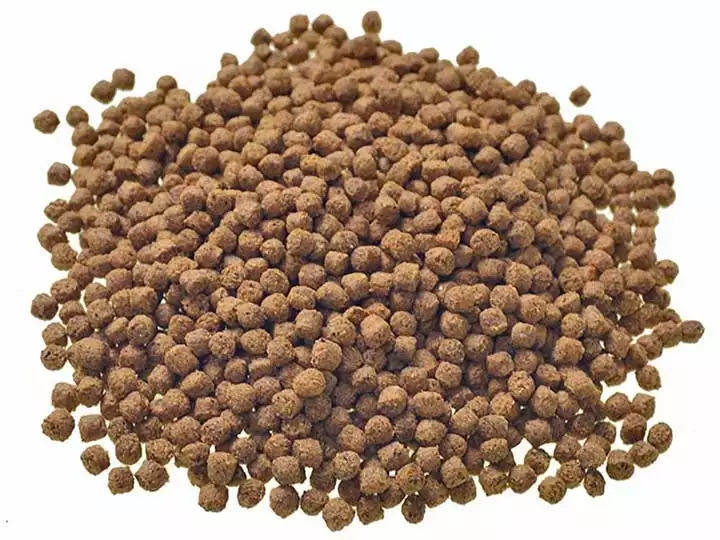
Floating vs Sinking Fish Feed: Which One Is Right for Your Farm?
Choosing between floating fish feed and sinking fish feed is one of the most important decisions in aquaculture. The wrong choice can waste feed, worsen water quality, and lower feed conversion ratios (FCR). But the right choice — matched to your fish species, farming method, and budget — can significantly boost productivity and profitability.
This guide breaks down the key differences between floating and sinking feed: the science behind buoyancy, which fish species need each type, the equipment required, a production cost comparison, and practical tips to help you make the right decision for your farm.
What Is Floating Fish Feed?
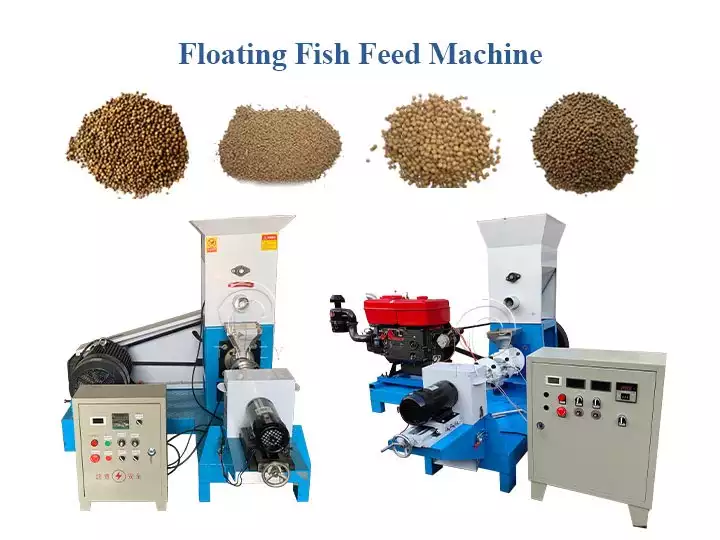
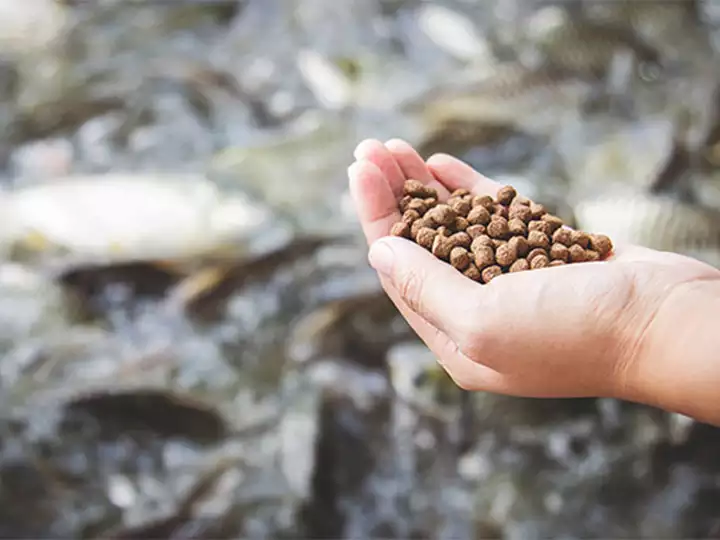
Floating fish feed — also called extruded feed or floating pellets — is designed to stay on the water surface for an extended period after being dropped into the pond. This buoyancy is engineered during the manufacturing process through a technique called cooking extrusion.
During extrusion, raw materials are mixed, conditioned with steam, and forced through a die under high pressure (up to 30–50 bar) and high temperature (120–150°C). As the hot, pressurized paste exits the die into atmospheric pressure, the moisture instantly flashes into steam, causing the pellet to rapidly expand. This creates a porous, low-density structure with tiny air pockets trapped inside — like a microscopic sponge — giving the pellet a density lower than water (typically 250–450 g/L).
The extrusion process also gelatinizes starches, which improves digestibility and nutrient absorption. The high temperature (above 120°C) reduces bacterial load and deactivates anti-nutritional factors in raw materials such as soybeans.
Key characteristics of floating feed:
- Bulk density: 250–450 g/L (lower than water)
- Pellet size: 1–10 mm, depending on the die mold
- Water stability: Can remain on the surface for 6–24 hours without dissolving
- Starch gelatinization: Above 90%, improving digestibility
- Production process: High-temperature, high-pressure extrusion
What Is Sinking Fish Feed?
Sinking fish feed — also called sinking pellets — is designed to sink below the water surface after being dropped into the pond. The key difference from floating feed is not a completely different machine, but rather a lower degree of expansion during extrusion, a denser formulation, and adjusted process parameters (temperature, pressure, moisture content, and screw configuration).
By reducing the expansion degree inside the extruder, the pellet emerges with fewer air pockets and a tighter internal structure. The result is a dense, compact pellet with a density higher than water (typically 550–700 g/L), causing it to sink steadily to the bottom of the pond.
Key characteristics of sinking feed:
- Bulk density: 550–700 g/L (higher than water)
- Pellet size: 1–8 mm
- Water stability: Sink within seconds; stays intact on the bottom for hours
- Starch gelatinization: 40–60% (lower than extruded feed)
- Production process: Extrusion with reduced expansion degree
Floating vs Sinking Fish Feed: Side-by-Side Comparison
| Parameter | Floating Feed (Extruded) | Sinking Feed (Pelleted) |
|---|---|---|
| Production method | Cooking extrusion (high temp, high pressure) | Extrusion with low expansion degree |
| Temperature | 120–150°C | 70–90°C |
| Bulk density | 250–450 g/L | 550–700 g/L |
| Behavior in water | Float on surface for 6–24 hours | Sink to bottom within seconds |
| Starch gelatinization | >90% | 40–60% |
| Digestibility | Higher (heat breaks down complex starches) | Moderate |
| Energy consumption | 80–150 kWh/ton | 30–60 kWh/ton |
| Feed monitoring | Easy — visible on surface, farmers can observe feeding behavior | Difficult — invisible underwater, cannot observe consumption |
| Water pollution risk | Lower — uneaten feed can be skimmed off | Higher — uneaten feed decays at the bottom |
| Production cost | Higher (energy + equipment) | Lower |
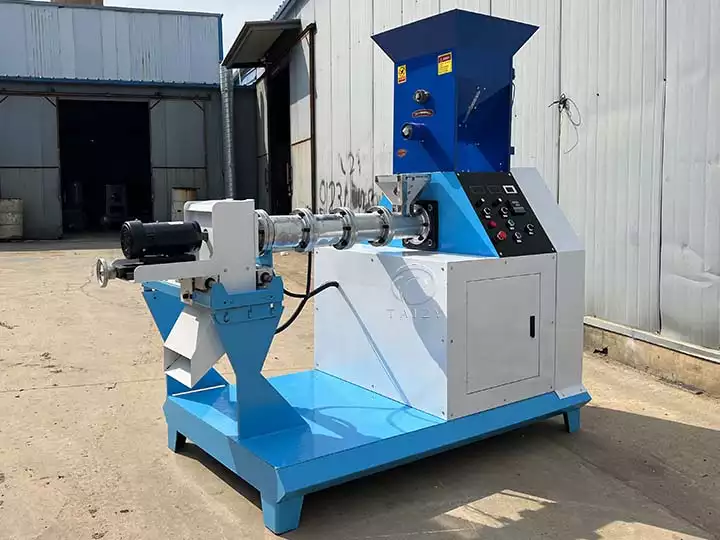
| Equipment required | Fish feed extruder (same machine can produce both) | Fish feed extruder (adjusted parameters) |
| Best for | Surface/mid-water feeding fish (tilapia, catfish, carp) | Bottom-feeding fish and shrimp (shrimp, crab, sea cucumber) |
The Science Behind Buoyancy: Why Does Feed Float or Sink?
The fundamental difference between floating and sinking feed comes down to density, which is determined during manufacturing. Importantly, the same fish feed extruder can produce both types — the difference lies in the process parameters, not the machine itself.
How floating feed achieves buoyancy: During extrusion, raw materials are subjected to extreme heat and pressure inside the barrel. The combination of temperature (120–150°C) and pressure (30–50 bar) causes the moisture in the material to become superheated. When the material exits the die into normal atmospheric pressure, this superheated moisture instantly expands into steam, creating thousands of tiny air pockets within the pellet. The result is a porous structure with a density lower than water — it floats.
How sinking feed achieves density: By adjusting the extruder’s parameters — lowering the temperature, reducing the screw compression ratio, increasing the feed moisture content, or modifying the die design — the expansion degree is significantly reduced. The pellet emerges with fewer air pockets and a tighter internal structure. Its density exceeds that of water — it sinks. The core control chain is: raw material formula → moisture content → screw/die configuration → temperature → pressure → expansion degree → pellet density.
In simple terms: high expansion → more air pockets inside the pellet → lower density → floating. Low expansion → denser, more compact pellet → higher density → sinking. The same extruder can switch between these modes by adjusting screw configuration, barrel temperature, and die design. This means customers do not need two separate machines — one extruder can serve both floating and sinking feed markets.
Which Fish Species Need Floating Feed?
Floating feed is ideal for fish that feed at or near the water surface or in the middle water column. These species naturally swim upward to grab food, and floating pellets allow farmers to monitor feeding behavior in real time.
- Tilapia — the most widely farmed fish globally; actively feeds at the surface
- Catfish (channel catfish, African catfish) — adaptable; readily eats floating pellets
- Grass carp — surface and mid-water feeder
- Common carp — omnivorous; feeds at multiple levels but responds well to floating feed
- Rohu / Indian major carp — mid-water column feeders
- Ornamental fish (koi, goldfish) — surface feeding allows visual monitoring
- Barramundi / Asian sea bass — aggressive surface feeders
- Turtle — surface basking feeders
The main advantage of floating feed for these species is feed visibility: farmers can see how much the fish are eating, adjust feeding rates in real time, and remove uneaten pellets before they pollute the water. This directly improves FCR and reduces water quality problems.
Which Fish Species Need Sinking Feed?
Sinking feed is essential for bottom-dwelling or bottom-feeding species that naturally forage at the pond floor. These animals would struggle to reach floating pellets at the surface.
- Shrimp (whiteleg shrimp, tiger prawn) — bottom feeders; require sinking pellets with high water stability
- Crab (mud crab, blue crab) — bottom-dwelling; need slow-dissolving sinking pellets
- Sea cucumber — strictly bottom-feeding; requires specialized sinking feed
- Eel — bottom-dwelling; prefers sinking paste or pellets
- Salmon (in some farming systems) — though often fed floating feed in net pens, certain stages use sinking feed
- Trout — can eat both, but sinking feed is common in raceway systems
- Sturgeon — bottom-feeding species; requires dense sinking pellets
For shrimp and crab farming specifically, sinking feed must have excellent water stability (resisting dissolution for 2+ hours underwater) because these animals eat slowly. This requires specialized formulations with higher starch binding agents and specific pelleting conditions.
Equipment Comparison: Extruder vs Pellet Mill
A common misconception is that floating feed requires one type of machine and sinking feed requires a completely different one. In reality, the same fish feed extruder can produce both — the difference is in the formulation and process parameters. The pellet mill is an alternative for customers who only need sinking feed at a lower equipment cost. Here is a practical comparison:
| Factor | آلة بثق أعلاف الأسماك (floating + sinking) | Flat Die Pellet Mill (sinking only) |
|---|---|---|
| Working principle | Screw extrusion with heat, pressure, and shear | Roller compression through a flat die |
| Temperature | 120–150°C (self-heating + external heating) | 70–90°C (friction-generated heat) |
| Capacity range | 40–350 kg/h (DGP series); up to 1–12 t/h for industrial twin-screw | 120–1200 kg/h (KL/KBL series) |
| Product versatility | Can produce floating, slow-sinking, and sinking feed by adjusting parameters | Primarily produce sinking feed only |
| Energy consumption | Higher (80–150 kWh/ton) | Lower (30–60 kWh/ton) |
| Price range | Higher initial investment | Lower initial investment |
| Key wear parts | Screw, barrel sleeve, die mold, cutting blade | Flat die, press roller |
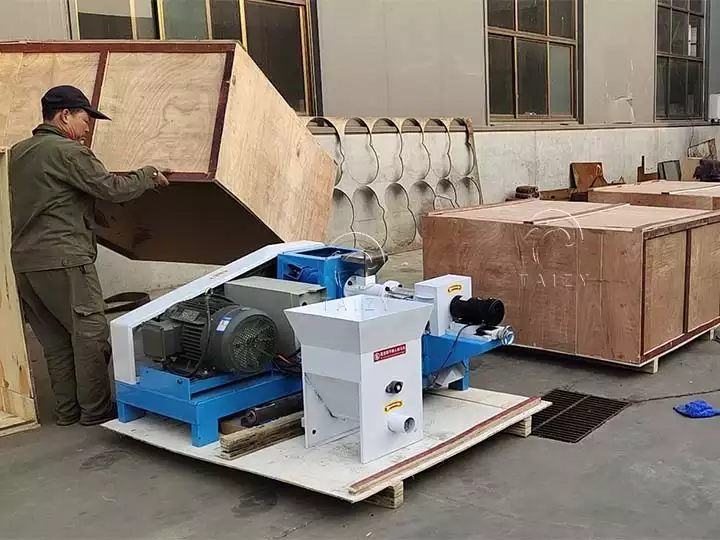
Our DGP series fish feed extruder (DGP-40 to DGP-80) covers capacities from 40 to 350 kg/h and can produce floating, slow-sinking, or sinking pellets by adjusting the screw configuration and processing parameters. This gives you the flexibility to serve multiple market segments with a single machine.
For customers who only need sinking feed at a lower cost, the KL/KBL series flat die pellet mill (120–1200 kg/h) is a more economical choice.
Cost Comparison: Is Floating Feed More Expensive to Produce?
When using the same extruder, the cost difference between floating and sinking feed is mainly in energy consumption — higher expansion requires more energy. If comparing an extruder (which can produce both types) against a pellet mill (sinking feed only), the equipment cost difference is more significant:
- Energy cost: Producing floating feed (high expansion) on an extruder consumes 80–150 kWh/ton. Producing sinking feed on the same extruder (low expansion) uses less energy. Using a pellet mill for sinking feed consumes only 30–60 kWh/ton. At 0.10/kWh, the electricity cost difference is approximaly 5-9/ton between floating and pellet-mill sinking feed.
- Equipment cost: An extruder (capable of both floating and sinking) typically costs 1.5–3x more than a pellet mill (sinking only). However, the extruder’s versatility means you serve two product lines with one machine.
- Nutrient loss: The high temperature of extrusion causes some heat-sensitive vitamin loss (estimated 5–15% for vitamins A, C, and some B vitamins). Post-extrusion coating can compensate for this.
- Offset savings: Better digestibility means less feed waste. Surface monitoring reduces overfeeding. Lower water pollution means less water treatment cost. For most farms, these savings offset the higher production cost within one production cycle.
As a reference, industry data shows that feed cost typically represents 50–70% of total aquaculture operating costs. Even a small improvement in FCR — from 1.8 to 1.5, for example — can save thousands of dollars per production cycle.
How to Choose: Floating or Sinking?
The decision depends on four factors:
- Fish species: Surface/mid-water feeders → floating. Bottom feeders → sinking. This is the primary deciding factor.
- Farm scale: Small to medium farms raising tilapia or catfish benefit most from floating feed due to easy monitoring. Large-scale shrimp farms need sinking feed with high water stability.
- Budget: A single fish feed extruder can produce both floating and sinking feed by adjusting parameters — this is the most versatile option. If capital is very limited and you only need sinking feed, a flat die pellet mill is the most affordable entry point.
- Market demand: In many markets, floating feed commands a higher selling price because of its perceived quality. Check local demand before deciding.
If you are starting a new fish feed business and are unsure which type to produce, we recommend a fish feed extruder. Since the same machine can produce both floating and sinking feed simply by adjusting the formulation and process parameters, you do not need to choose between them — one extruder gives you maximum flexibility to serve all customer segments.
Conclusion: Match the Feed to the Fish
There is no universally “better” choice between floating and sinking feed — the right answer depends entirely on what you are farming. Surface-feeding species like tilapia, catfish, and carp thrive on floating feed. Bottom-dwelling species like shrimp and crab require sinking feed.
If you are entering the fish feed production business, a fish feed extruder is the most practical investment — it produces both floating and sinking pellets from a single machine by adjusting the formulation and process parameters. You do not need separate machines for each type. For customers focused exclusively on sinking feed at the lowest equipment cost, a flat die pellet mill is the economical entry point.
Need help choosing the right equipment for your specific situation? Contact our team — we can recommend the optimal configuration based on your target fish species, production capacity, and budget.